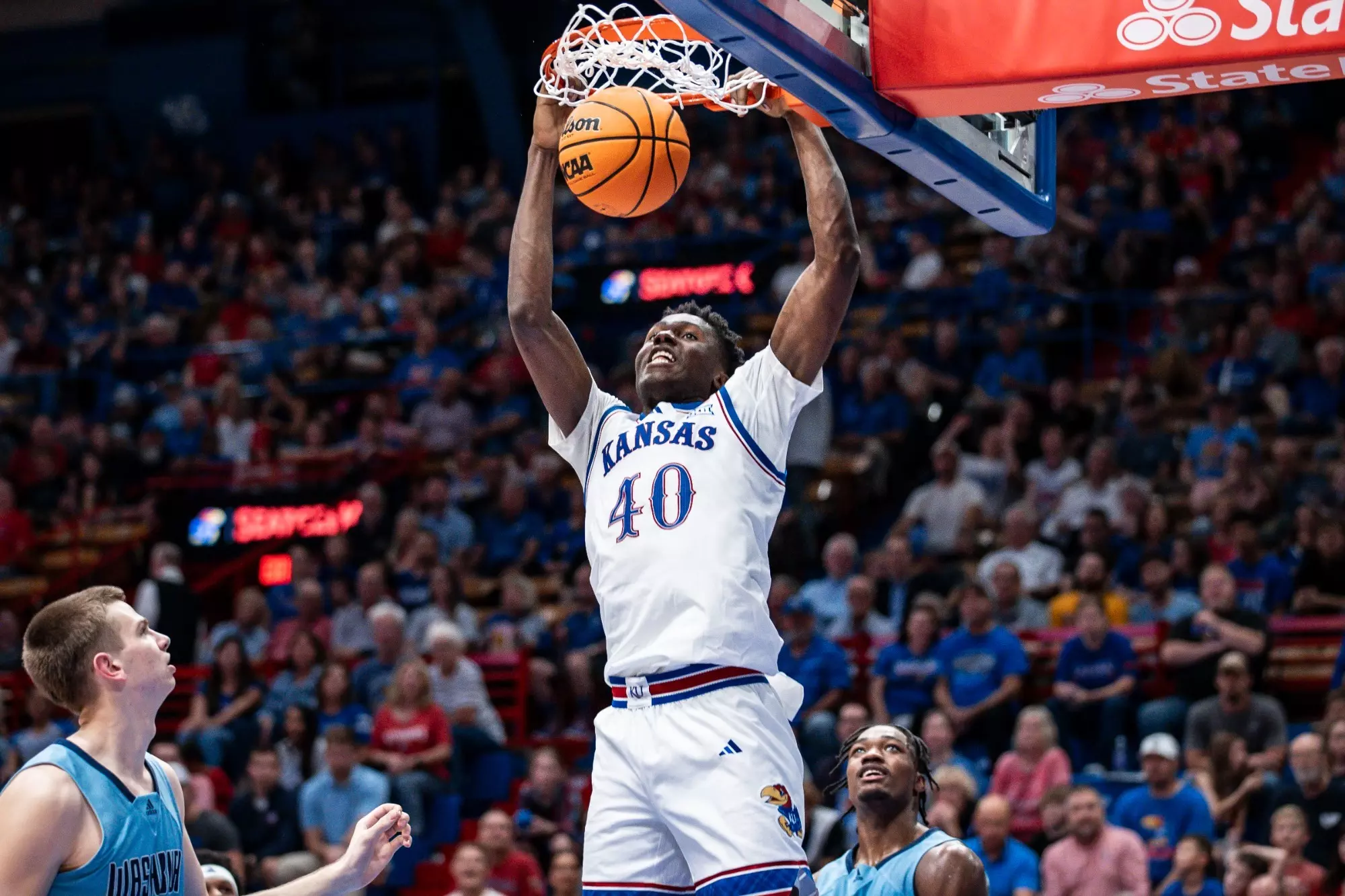
College basketball is a sport where one elite interior player can completely change the identity of a team. In an era dominated by spacing, shooting, and guards creating offense, the teams that can consistently defend the rim and control the glass still have a massive advantage when March arrives.
That is why Louisville’s addition of Flory Bidunga could end up being one of the most important moves of the offseason.
The Cardinals did not just add a talented big man. They added a player who impacts the game in the exact areas that are hardest to find: rim protection, rebounding, finishing efficiency, and defensive versatility. Bidunga’s arrival gives Louisville the type of interior presence that can turn a good roster into a legitimate threat.
The numbers back it up.
Louisville Added an Elite Defensive Anchor
The easiest way to understand Bidunga’s value is by looking at what he does when opponents attack the basket.
During his final season at Kansas, Bidunga averaged 2.6 blocks per game while leading the Big 12 with 91 total blocks. He ranked among the national leaders in block rate and established himself as one of the best defensive big men in the country.
But blocks only tell part of the story.
A great rim protector changes opponent behavior. Guards hesitate before driving. Big men become less aggressive around the basket. Teams settle for tougher midrange attempts instead of attacking the paint.
That type of defensive value does not always appear in traditional box scores.
Louisville’s biggest weakness in recent years has been its ability to consistently control the paint against elite competition. Adding a 6-foot-10 athlete who can erase mistakes behind the defense immediately raises the floor of the entire team.
Instead of needing every possession to be perfectly defended, Louisville now has a safety net.
The Efficiency Is Impossible To Ignore
Offensively, Bidunga is not a high-volume shot creator, but analytics suggest he does exactly what elite college centers should do.
He is extremely efficient.
Bidunga shot 64% from the field last season, ranking among the best marks in the country and leading the Big 12. He averaged 13.3 points and 9.0 rebounds per game while producing 13 double-doubles.
That efficiency comes from playing a role that translates well to winning basketball:
- Elite finishing around the rim
- Offensive rebounding
- Lob finishing
- Creating second-chance opportunities
- Punishing smaller lineups
In modern college basketball, a center does not need to average 20 points to be an offensive weapon. A player who converts a huge percentage of his attempts while forcing defenses to collapse creates value without dominating possessions.
Bidunga’s offensive profile fits perfectly next to talented guards because he does not need the ball constantly to impact the game.
The Guard Play Makes Him Even More Dangerous
The biggest reason Louisville could become a nightmare matchup is that Bidunga is not joining a rebuilding roster.
The Cardinals surrounded him with athletic wings and high-level perimeter talent, including guard Jackson Shelstad. The combination of elite guard play and a dominant interior presence is one of the most difficult formulas to defend in college basketball.
When teams try to stop penetration, Bidunga becomes a target for lobs and dump-offs.
When teams collapse on him, Louisville’s guards get open looks.
When teams play smaller to match Louisville’s perimeter speed, Bidunga can punish them on the glass.
It creates a matchup problem because there is no obvious weakness to attack.
Rebounding Could Become Louisville’s Biggest Advantage
The NCAA Tournament often comes down to possession battles.
Turnovers matter. Shooting matters. But extra possessions decide close games.
Bidunga averaged 9.0 rebounds per game at Kansas, giving Louisville a legitimate elite rebounder in the frontcourt.
That matters because offensive rebounding is one of the easiest ways to generate efficient offense. A missed shot that turns into a putback is essentially a possession extension without needing to run another offensive set.
Defensively, ending possessions is just as important. A team can force a bad shot, but if it cannot secure the rebound, the defense was wasted.
Bidunga solves that problem.
The Ceiling Is Higher Than The Numbers
The most intriguing part of Bidunga’s profile is that he still feels like a player with room to grow.
He has already become an elite defender and efficient scorer without being a major offensive focal point. If Louisville can expand his passing, improve his touch away from the basket, or develop more post scoring, his impact could jump again.
That is what makes him different from a traditional defensive specialist.
He is not a player Louisville is hoping can survive offensively.
He is already productive.
The question is whether he can become a player who completely controls games.
Louisville Has The Formula For March
Every year, there are teams that look dangerous because they have talented players. But the teams that make deep tournament runs usually have something more specific:
- A guard who can create offense
- Elite defensive ability
- Rebounding
- Efficiency
- Players who fill defined roles
Louisville now checks almost every box.
Flory Bidunga gives them a defensive identity and a reliable interior advantage. The perimeter talent gives them offensive versatility. Together, they create a roster that can win different styles of games.
College basketball is unpredictable, and no team is guaranteed a deep run. But if Louisville is looking for a blueprint to become a legitimate national contender, adding one of the best defensive big men in the country was the perfect place to start.
The Cardinals are not just talented.
They are built to be a problem.
Leave a Reply